
Asana of the month
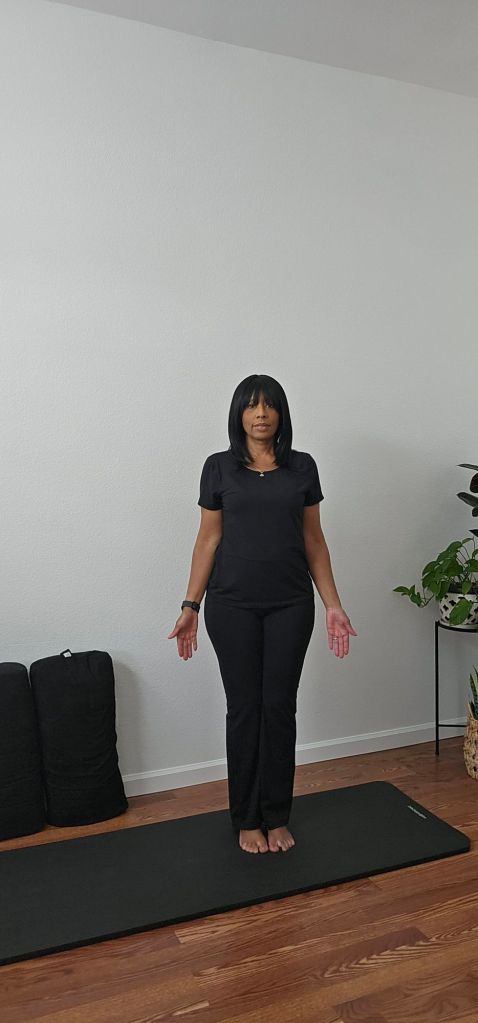
More than meets the eye, Tadasana, also known as “Mountain Pose,” is a foundational yoga posture that focuses on alignment, grounding, balance, breath awareness, and the flow of prana along the spine. A seemingly simple yoga asana, this pose, when practiced with intention, is a little more challenging than just standing,
In Sanskrit “Tada” refers to the word “mountain” and “Asana” refers to the word “posture” and when practicing Tadasana the qualities of a mountain, such as creating a strong foundation, stability and balance, are embodied by the practitioner.
This pose is also referred to as Samasthiti in the Ashtanga lineage with “Sama” meaning “equal” and “sthiti” meaning “standing still” in Sanskrit.
Frequently practiced as a neutral or transitional pose in between other poses in a yoga sequence, Tadasana allows the body to unite one pose to the next one that follows in a standing sequence with ease.
Some of the benefits of practicing this asana are that it helps improve posture by helping to align the spine, shoulders and pelvis. It can also help strengthen the core muscles as the abdominal muscles are engaged while practicing helping to stabilize the core muscles, as well as muscles in the lower back and lower body.
Tadasana also helps increase strength and stability in the legs, ankles and feet; benefitting balance and coordination as the muscles of the legs are engaged, assisting in the creation of a solid foundation. This pose can help elongate the spine and reduce disc compression when maintaining a straight back, lifting through the crown of the head and maintaining alignment in the body, thereby promoting spinal health, flexibility and improved posture. It can also help promote circulation and energy flow throughout the body, reduce and relieve tension in the shoulders, neck and upper back through the opening of the chest.
A few pose variations that are available for Tadasana include keeping the feet hip width apart, raising the arms, integrating eagle arms, lifting the heels, using a wall for support, and practicing Tadasana while seated in a chair or lying down.
Tadasana offers a rich opportunity for the inclusion of meditative engagement through the integration of breath awareness and inner observation. A subtle but satisfying benefit of this posture. Whether practiced as a part of a yoga sequence, or solely on its own, this pose provides yoga practitioners with a powerful tool for fostering internal and external strength and developing stability, presence, centeredness and discipline.
How to practice Tadasana
- Stand up tall and broad.
- Elongate the spine.
- Place your feet and toes together evenly. Feet may be together with toes touching, slightly apart, or the feet may be hip width apart.
- Gently rock your feet forward, backward and side to side to help evenly distribute your weight throughout all sides of your feet to help establish a firm base.
- Ground or root yourself to the earth (or floor) and ensure that your body feels evenly balanced and comfortable.
- Keep your hips facing forward.
- Keep your thighs + knees facing forward.
- Keep your ears over your shoulders.
- Keep your chin aligned with your chest.
- Keep the crown of the head lifted.
- Maintain engagement of your core.
- Keep your shoulders rolled back slightly and aligned with your hips.
- Relax the shoulders.
- Open the chest keeping the sternum lifted upward + the ribs soft
- Extend your arms downward along both sides of your body,
- Place the palms of your hands faced forward. (A few other variations include: placing the hands in Anjali Mudra or “prayer hands” at the chest, or arms raised above the head with fingers of the hands pointed upward.)
- Keep your gaze forward at eye level.
- Hold the pose for a few minutes.
Holding Tadasana for a few breaths, maintaining a steady gaze and allowing yourself to become aware of any sensations, and the effects of this posture before moving onto another one can serve as a way to invigorate and enrich your practice.
A short list of additional benefits of Tadasana include:
- May be helpful for sciatica and lower back pain.
A short list of contraindications for Tadasana include:
- Ankle or knee injury, ankle or knee surgery, knee osteoarthritis, and spinal surgery.
Be sure to check with your physician prior to practicing this pose. If you are able to practice this pose, try exploring different variations of the posture to better meet yourself where you are whenever you practice – whether that be to practice a gentler variation, or one that provides you with an opportunity to challenge yourself a little bit, if that is a part of your yoga journey.
 Salubrity + Soul Yoga