
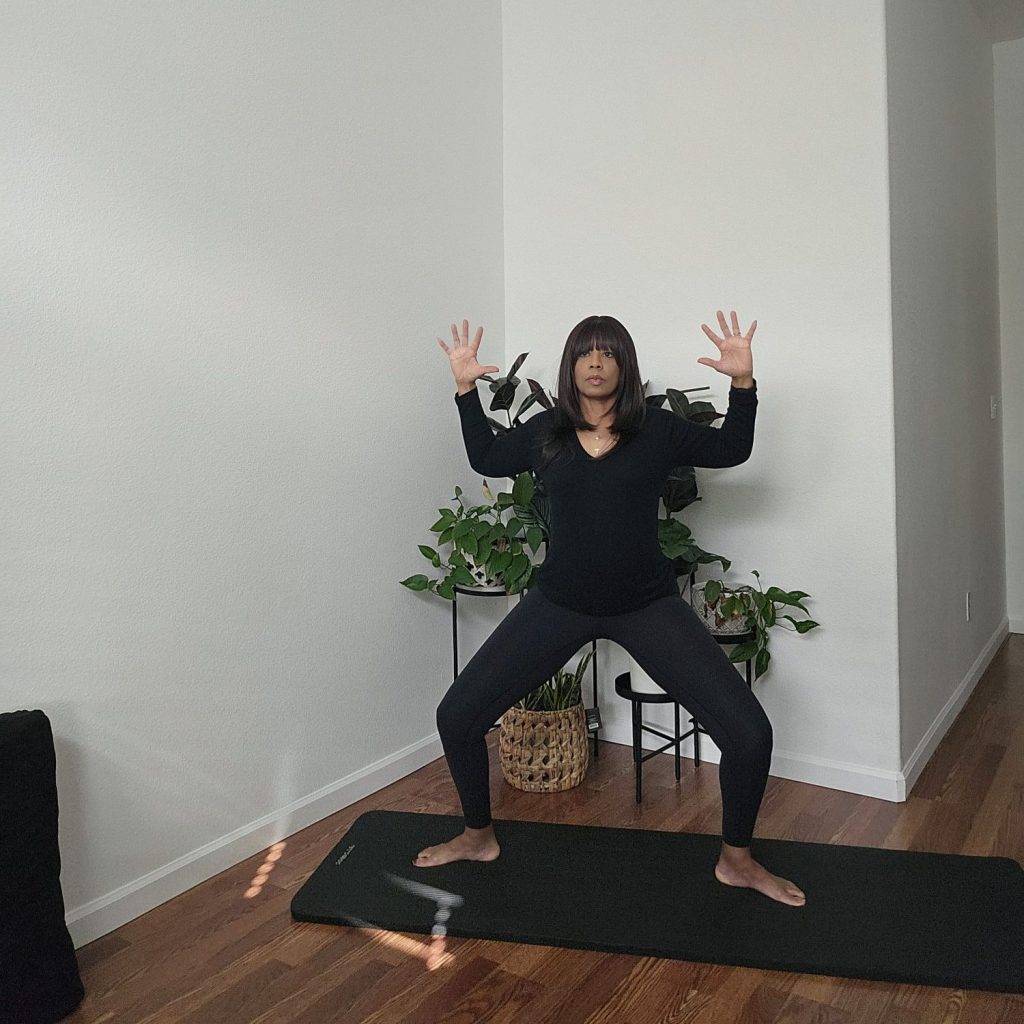
Philosophical Insight
In yoga, Goddess Pose in more than a physical stance, it is an embodied reflection of empowerment and of Shakti, the primordial feminine energy that moves through all creation. When we are in this posture, we encounter the delicate balance between sthira (steadiness) and sukha (ease). learning that strength and softness aren’t opposites, but expressions of the same consciousness.
To practice Goddess Pose is to honor both the power that holds us upright and the surrender that allows us to remain open. In this pose our legs root into the ground, reminding us to take on the characteristics associated with stability and grounding, while our heart remains lifted. The heart lifted, reminds us to be receptive, expansive and unguarded. This asana becomes a meditation on duality of power and grace, effort and ease, and form and flow.
In a world that often equates strength with rigidity, Goddess Pose teaches a more profound lesson, which is that true power; that of strength of presence, grace and grounded resilience arises when effort meets awareness and intention guides action. This asana invites us to connect with our inner Shakti. It is a posture that encourages not just physical engagement, but a reflection on the qualities that make us strong, supple and whole. It reflects the inner dialogue between strength and softness and effort and surrender. Each moment in this pose is an invitation to embody balance.
Understanding the Pose
Goddess Pose begins from the foundation of the body, which is that of the feet. The feet turn outward, knees are bent, hips are descended into a wide, steady stance. This base not only strengthens the legs and glutes, but also stimulates the root chakra (Muladhara), which is the energetic seat of grounding, stability and presence.
As the spine lengthens and the arms open into cactus shape, the chest lifts, engaging the heart chakra (Anahata), which is the energetic center of courage, compassion and openness.
This interplay of groundedness and lifting mirrors the subtle equilibrium that yoga encourages, which is the coexistence of strength and receptivity.
How to Practice Goddess Pose
- Find your stance. Begin by standing tall in Tadasana (Mountain Pose). Step your feet out wide (roughly about two to three feet apart depending upon your body’s structure.) Turn your toes out to approximately 45 degrees and your heels slightly in. Allow your rotation to originate from the hips instead of the knees or ankles.
- Establish a stable foundation. Press evenly through the four corners of each foot. (The base of the big toe pinky toes and inner and outer heel.) Engage the arches of your feet slightly and root down into the ground while creating a lift through the legs and the pelvis.
- Bend your knees. Lower your hips toward knee level. Keep the knees aligned over the the toes, avoid collapsing inward or outward. Draw the tailbone slightly down while lengthening the spine upward, maintaining a natural curvature of the spine.
- Lift through the spine. Maintain length from tailbone to crown, ensuring the chest lifts without overarching the lower back.
- Open the arms. Bring the arms into cactus shape (elbows bent around 90 degrees, wrists in line with the shoulders, palms forward.) Draw the shoulders down and away from the ears, broaden across the collarbones, and allow the chest to expand. Avoid flaring the ribcage forward or collapsing inward. Allow your breath to guide the lift nautrally.
- Breathe and hold. Remain in this posture for 5 to 8 breaths (30 -60 seconds).
- To release from this pose. Straighten the legs, and lower the arms. Bring the feet together into a neutral stance such as Tadasana (Mountain Pose).
Additional Variations
Chair Goddess Pose:
Sit at the edge of a sturdy chair with feet wider than your hips, and toes slightly turned outward. Engage your legs and your core. Keep the spine tall. Hands may rest on your thighs or be positioned in cactus shape. This variation maintains the integrity and essence of the pose while reducing strain on the knees and hips.
Wall Support:
Stand near a wall Press your hands lightly against the wall at shoulder height for additional balance support. You can also try placing your back against the wall for more stability.
Gentler Variation:
For a softer approach to this pose, try keeping a slight bend in the knees and not lowering the hips down as much, and bring your hands to heart center (Anjali Mudra), if preferred over cactus arms. Focus on breath, presence and awareness rather than the depth or intensity of the posture.
Common Misalignments
- Knees collapsing inward – Engage outer hips and thigs to maintain alignment.
- Ribs flaring forward – Draw front ribs toward the spine and lengthen through the torso.
- Shoulders creeping toward the ears – Relax the shoulders and broaden across the upper back.
Benefits of this pose:
- Strengthens the legs, hips and core.
- Opens the chest shoulders, and upper back.
- Improves balance and stability.
- Enhances circulation and endurance.
- Helps cultivate confidence, steadiness and presence.
Contraindications:
Avoid, modify or try a different variation if you have:
- A knee, hip or ankle injury
- Pelvic or sacral instability
- Balance limitations
Gentle Reminder: Always honor your body’s limits. Your presence, safety and benefit is more important than the depth or aesthetics of your pose.
 Salubrity + Soul Yoga